Product owners and managers often face specific operational hurdles. For example, they might rush a product release because one stakeholder missed a sprint deadline or scramble to pull together a roadmap update just days before a board review. According to the report by Airfocus, 50.8% of product managers cite “insufficient time” as a key challenge.
This lack of time often stems from managing too many competing priorities: urgent updates, stakeholder requests, and shifting deadlines. To combat this, many product managers are turning to AI tools that can automate repetitive tasks and streamline scheduling.
In this blog, we’ll explore the Top 10 AI Tools for Product Owners and Managers in 2026, designed to help you save time and improve your efficiency.
Key Takeaways:
- AI-driven time optimization: Product owners and managers face a critical challenge in managing time effectively. AI tools like Clockwise offer intelligent scheduling that automatically adjusts meetings to preserve focus time.
- Streamlining daily workflows: AI tools help automate repetitive tasks, from feedback synthesis to report generation, freeing up time for more strategic work and decision-making.
- Agile support: Tools like Mixpanel, Spark AI, and Pendo AI are key for agile product teams, enhancing sprint planning, backlog refinement, and providing real-time insights to adjust course quickly.
- Enhancing stakeholder communication: AI-powered platforms assist in preparing reports, summarizing meetings, and generating updates for stakeholders, enabling clearer and faster communication.
- Data-driven decisions: Tools like Kraftful and NotebookLM leverage AI to analyze user feedback and product data, ensuring product managers can prioritize effectively and build data-driven roadmaps.
How AI Tools Support Product Owners and Managers
AI tools help product owners and managers by automating repetitive tasks, generating actionable insights, and supporting agile execution and project management, so teams can focus on value‑driven work instead of firefighting. Here’s how they apply in real workflows:
- Backlog and sprint planning: AI analyzes historical sprint data, suggests prioritization of work items, and estimates effort to make planning faster and more accurate.
- Sprint execution and monitoring: Tools forecast workload capacity, identify dependencies or blockers early, and produce actionable alerts during the sprint cycle.
- User feedback and research synthesis: AI mines user responses, support tickets, and surveys to detect patterns and surface feature ideas or risks in product development.
- Stakeholder updates and reporting: Generative models create executive summaries, dashboards, or status reports in minutes, reducing manual effort and improving clarity.
- Roadmap prioritization and strategy alignment: AI evaluates market trends, product performance, and usage data to support decisions on what to build next and when.
Also Read: AI Task Managers and Scheduling Tools for 2025 | Clockwise
List of Top 10 AI Tools for Product Managers
Each of these tools has been carefully selected based on its ability to streamline agile workflows. Let’s explore how these AI-driven solutions can help you optimize your day-to-day operations and move your product development forward with greater ease.
1. ChatPRD
Source:- https://www.chatprd.ai/
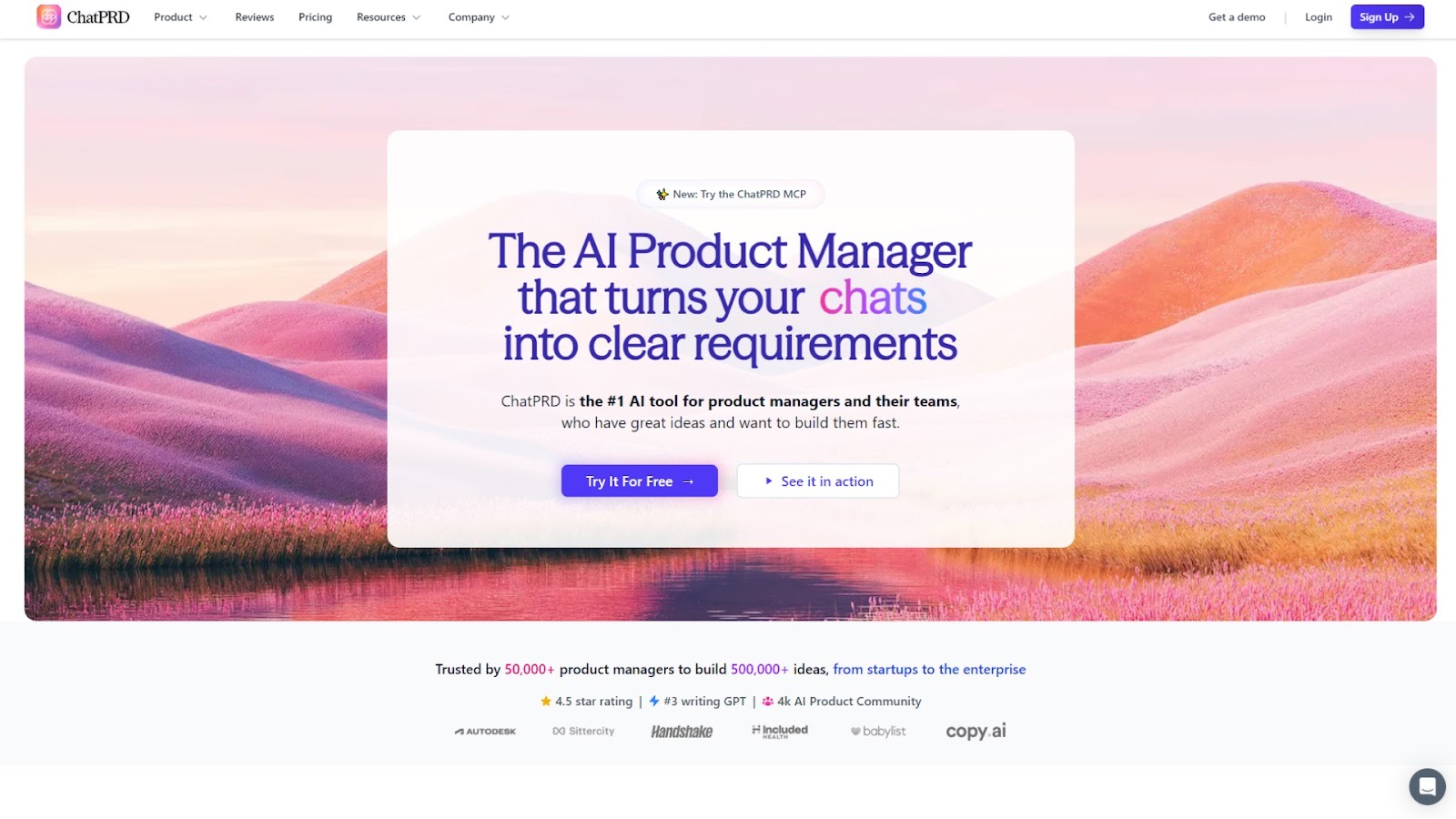
ChatPRD is an AI‑powered platform built specifically for product owners and managers to quickly generate and refine product documentation. It converts basic inputs, such as ideas, sketches, or customer feedback, into structured artifacts like Product Requirement Documents (PRDs), user stories, and roadmaps.
Key Features
- Rapid PRD Generation: Create comprehensive PRDs from simple prompts, enabling you to move from concept to document in minutes, freeing time for strategy and stakeholder work.
- Document Improvement & Feedback: Import existing specs and get AI suggestions to sharpen clarity, fill gaps, and align with best practices, reducing revision cycles and miscommunication.
- Custom Templates & Role‑Adapted Output: Use built‑in templates or create your own for consistency across teams (engineering, design, product) and ensure artefacts align with your workflow.
- Team Collaboration & Shared Workspace: Built‑in support for team workspaces, shared documents, and version control helps product leaders manage documentation at scale across multiple stakeholders.
- Enterprise‑Grade Data Security: Features like SOC 2 Type II compliance, end‑to‑end encryption, and private data handling mean you can use ChatPRD even when you’re dealing with sensitive product strategy.
Free Plan & Pricing Models
ChatPRD offers a free trial option, allowing you to explore the platform before upgrading.
- Basic: $8/month (or $60/year) with unlimited chats, document templates, and file uploads.
- Team: $24/user/month (or $204/year/user) for team workspace features, shared templates, and centralized billing.
2. Clockwise
Source:- https://www.getclockwise.com/
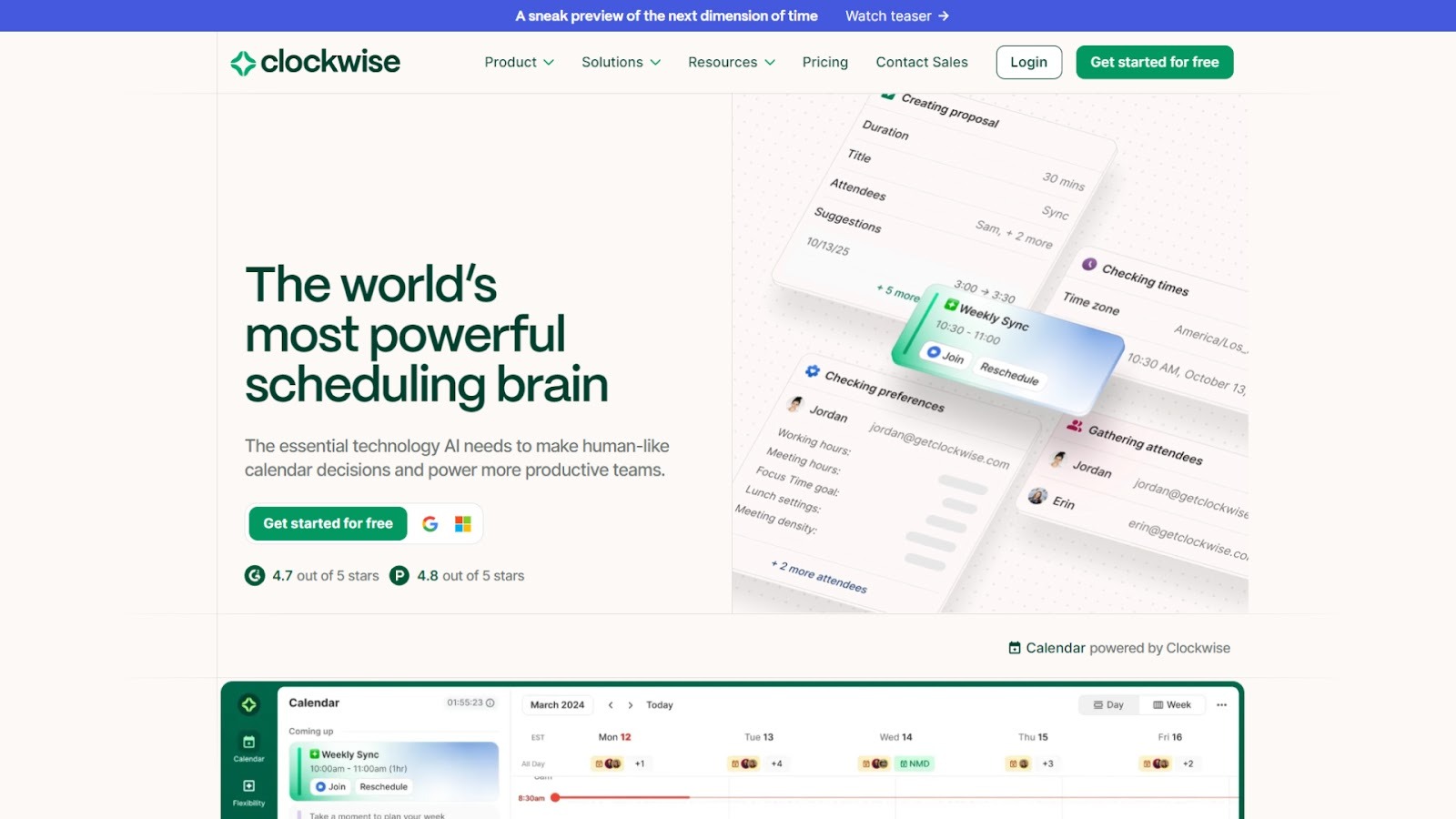
Clockwise is an AI‑powered calendar assistant that automates scheduling and protects time for deep work by continuously analyzing calendar data across individuals and teams. It helps you reduce scheduling conflicts, block out meaningful time for strategy or review, and keep your calendar aligned with how you need to work.
Key Features
- Preference Learning: Learns how you and your team like to work and adapts scheduling accordingly.
- Predictive Scheduling: Anticipates conflicts across calendars and suggests optimal meeting times ahead of issues impacting your day.
- Real‑Time Optimization: Continuously tests millions of calendar permutations to adjust meetings and tasks as things change.
- Flexible Holds: Allows you to block tentative time on your calendar (for tasks, routines, breaks) and automatically shifts it as your schedule evolves.
- Focus Time Blocks & Auto‑Decline: Reserves uninterrupted blocks for deep work and can automatically decline meetings that overlap with those focus periods.
- Team‑Wide Analytics & Meeting Culture Insights: Offers dashboards showing how meeting loads and focus time vary across teams, helping leaders identify bottlenecks and calendar health.
Free Plan & Pricing Models
- Free Plan: Includes basic calendar sync, flexible holds, and scheduling links.
- Teams Plan Pricing: $6.75 USD per user/month (billed annually). Includes advanced calendar optimisation, Focus Time holds, and group scheduling links.
3. NotebookLM
Source:- https://notebooklm.google/
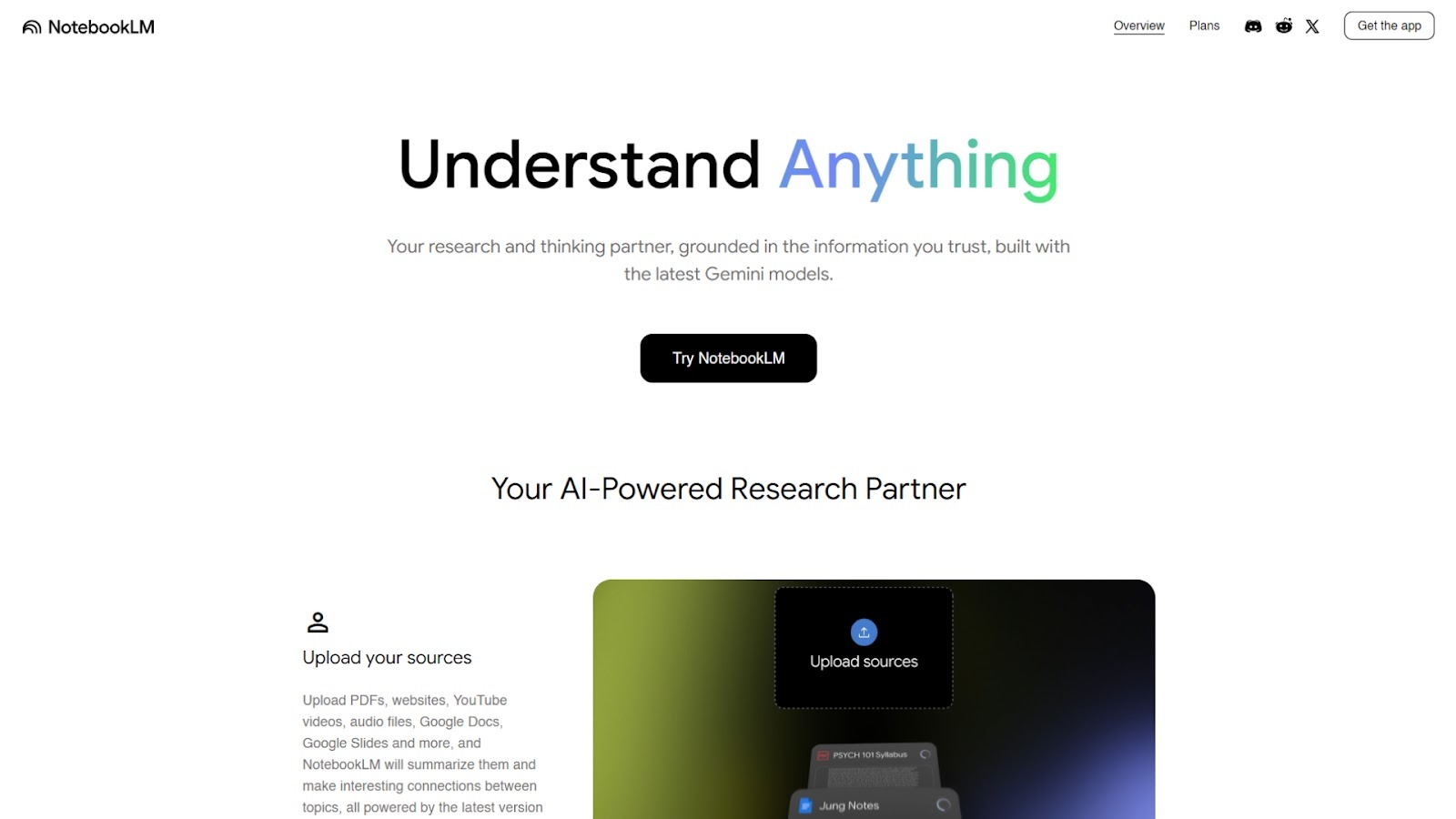
NotebookLM is an AI‑powered research and knowledge‑assistant platform that allows you to upload documents, slides, PDFs, and web content, then ask questions, generate summaries, and turn complex source materials into usable insights.
Key Features
- Source‑grounded AI chat interface: Upload your team’s product specs, research documents, or user feedback, and chat with NotebookLM to get tailored answers. Helps product owners quickly surface insights from large volumes of unstructured content
- Audio Overviews & interactive summaries: Converts uploaded content into audio summaries or conversation‑style reviews. Ideal for product managers on the move who need to absorb key information without reading through long reports.
- Custom response styles and format templates: Customize how NotebookLM generates output (e.g., executive brief, user story, decision memo). This helps POs/PMs tailor insights to different stakeholders (execs, engineers, design).
- Enterprise‑ready security and privacy controls: For teams handling sensitive product roadmaps or IP, NotebookLM offers Workspace‑grade protections and guarantees that uploaded data won’t train external models.
- Central knowledge hub for distributed teams: Enables collective upload and shared exploration of research, enabling multiple product team members to query the same base of documents, reducing duplication and increasing alignment.
Free Plan & Pricing Models
NotebookLM offers a free tier through Google Workspace with core features available for business use.
4. Mixpanel Spark AI
Source:- https://mixpanel.com/home/
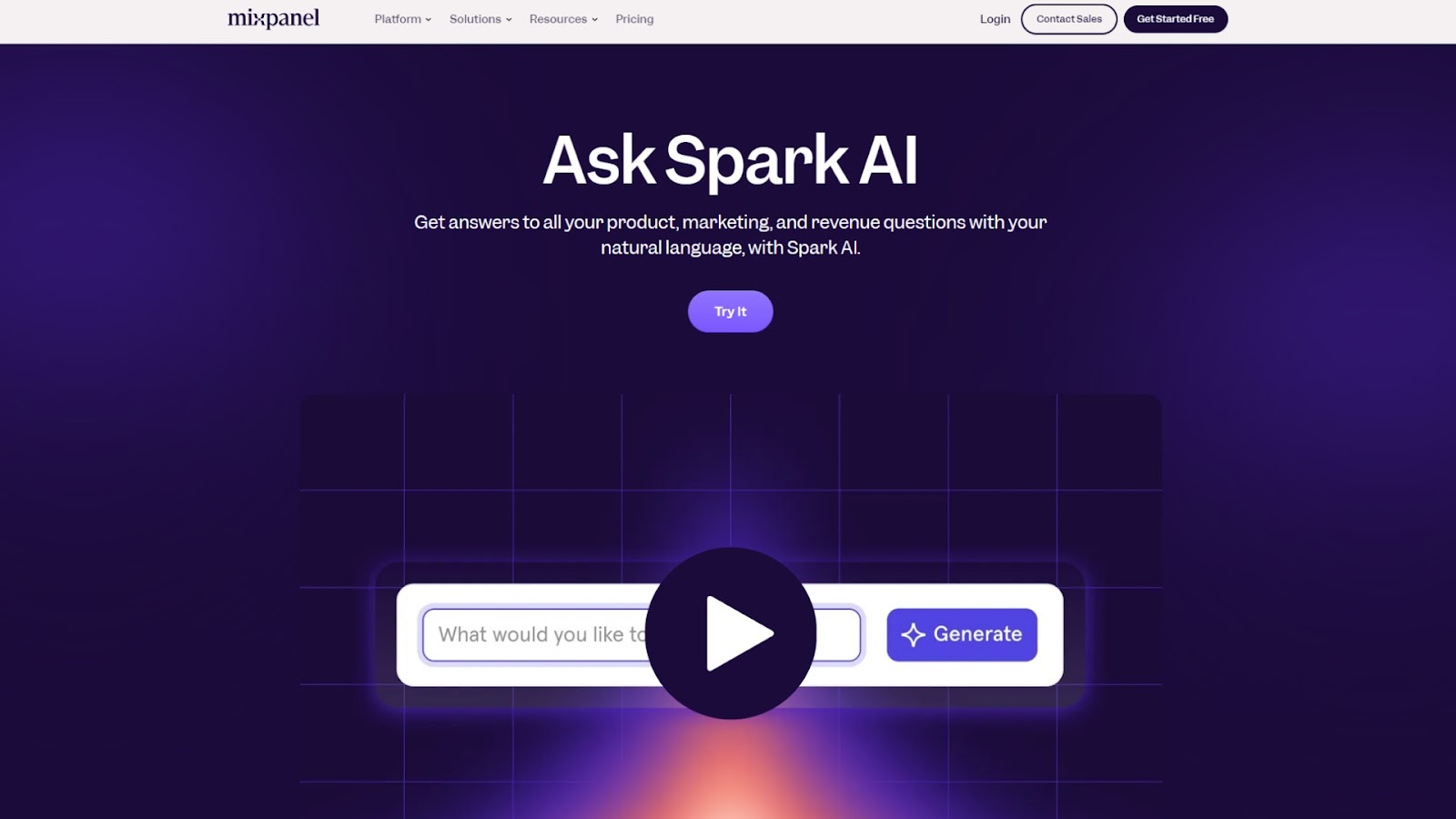
Mixpanel Spark is a generative-AI-powered analytics tool built into the Mixpanel product platform, enabling product owners and managers to query their data in natural language and generate charts, insights, and follow‑up drills without needing SQL or BI expertise.
Key Features
- Natural‑language query interface: Ask questions like “How did our retention change last quarter by region?” and Spark delivers a chart plus a full model of how it was generated. Great for product stakeholders who need insight fast without deep data team support.
- Iteration and follow‑up prompts: After an answer, you can ask follow‑up questions (e.g., “Break that down by device type”) to dig deeper. Helps product owners refine analysis on the fly.
- Transparency of AI reasoning: Spark shows you the underlying queries used to generate its answer, meaning product owners can validate or modify rather than accept a black‑box result.
- Enterprise‑grade data governance: Includes controls like disabling AI for select data sets, ensuring compliance in data‑sensitive environments—critical for product teams in regulated industries.
- Zero coding required: Reduces reliance on engineering or data science teams for routine analysis, allowing product owners to move faster and make decisions with fewer bottlenecks.
Free Plan & Pricing Models
Mixpanel offers a free plan that supports up to 1 million monthly events, including access to Spark for a capped number of prompts.
5. Pendo AI
Source:- https://www.pendo.io/
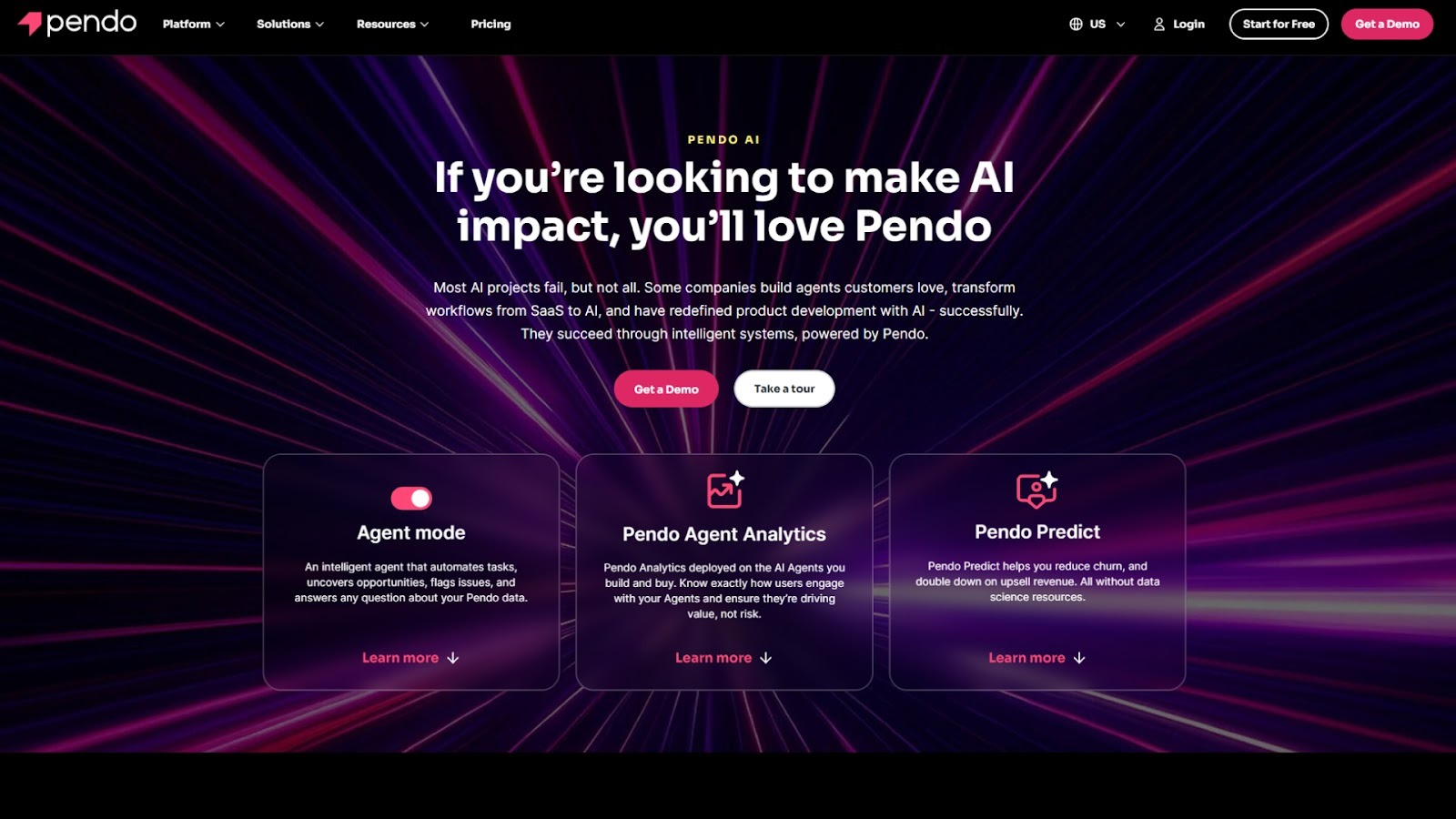
Pendo AI is an analytics‑driven platform designed to help product owners and managers turn user behavior into meaningful insights. It enables teams to identify which users are at risk of churn, surface trends in product usage, and deliver guidance through integrated in‑app messages.
Key Features
- Predictive Model Insights: Pendo uses AI to flag users and accounts likely to churn or convert, allowing product owners to act before issues escalate.
- Behavior Analytics & Paths: Chart how users move through your product and identify friction points without needing complex SQL queries, enabling faster decision‑making.
- In‑App Guides and Messaging: Trigger tailored messages for users at precise moments (e.g., when they hit a roadblock), supporting adoption and reducing support load.
- Feedback & Sentiment Tracking: Collect NPS, feedback, and in‑app comments; Pendo’s AI then surfaces themes and trends, so that you can prioritize roadmap items effectively.
- Enterprise‑Grade Data Governance: Trust built‑in compliance (SOC‑2, GDPR) and flexibility to push data into BI systems for custom workflows and large‑team deployments.
Free Plan & Pricing Models
Pendo offers a free entry tier with basic analytics features; full AI capabilities in the workplace and enterprise tier pricing are available by contacting sales
6. Kraftful
Source:- https://www.kraftful.com/
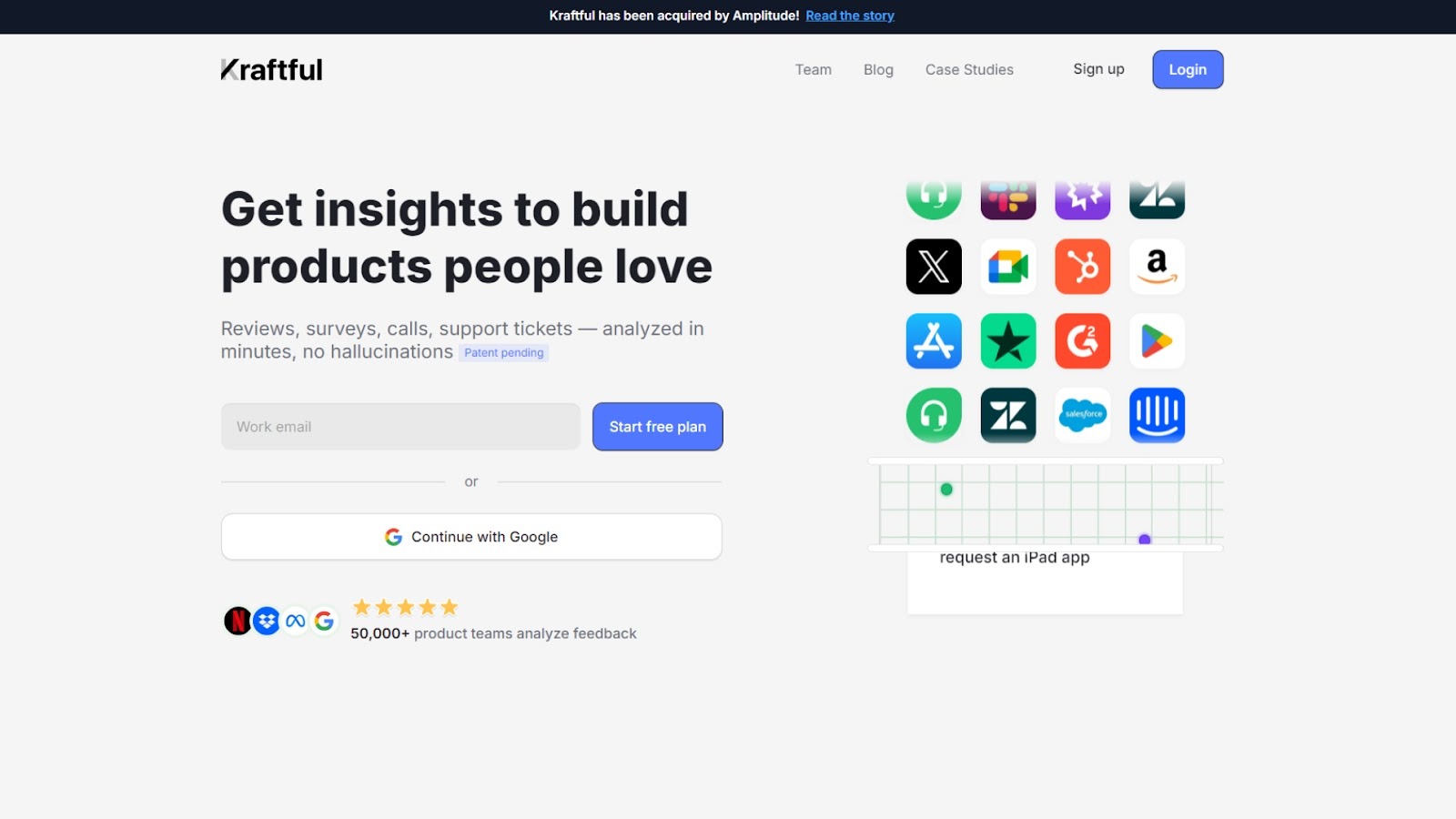
Kraftful is an AI research and feedback platform that helps product teams process large volumes of user comments, support tickets, and survey data into actionable insights. It’s built to streamline how product owners turn user sentiment into roadmap decisions.
Key Features
- Feedback‑driven Insight Engine: Kraftful automatically sorts feedback into feature requests, complaints, and praise, so product owners spend less time sifting and more time deciding.
- Custom Surveys & AI‑Interviews: Generate surveys or AI‑led interviews in seconds based on existing feedback, aiding user research with minimal manual effort.
- Actionable User Stories Export: Convert insights directly into user stories with acceptance criteria and push to tools like Jira or Linear, speeding up the transition from research to execution.
- Trend Tracking Over Time: View how mentions of a feature or issue evolve week by week, helping product owners monitor improvement or decline post‑release.
- Global Language Support & Privileged Security: Offers translation and data handling for global teams, backed by SOC‑2 compliance, so you can trust the insights for strategic decisions.
Free Plan & Pricing Models
Kraftful offers a free tier allowing access to core features; upgrades to “Pro” or “Team” tiers with expanded limits and collaboration features are available.
7. Otter.ai
Source:- https://otter.ai/
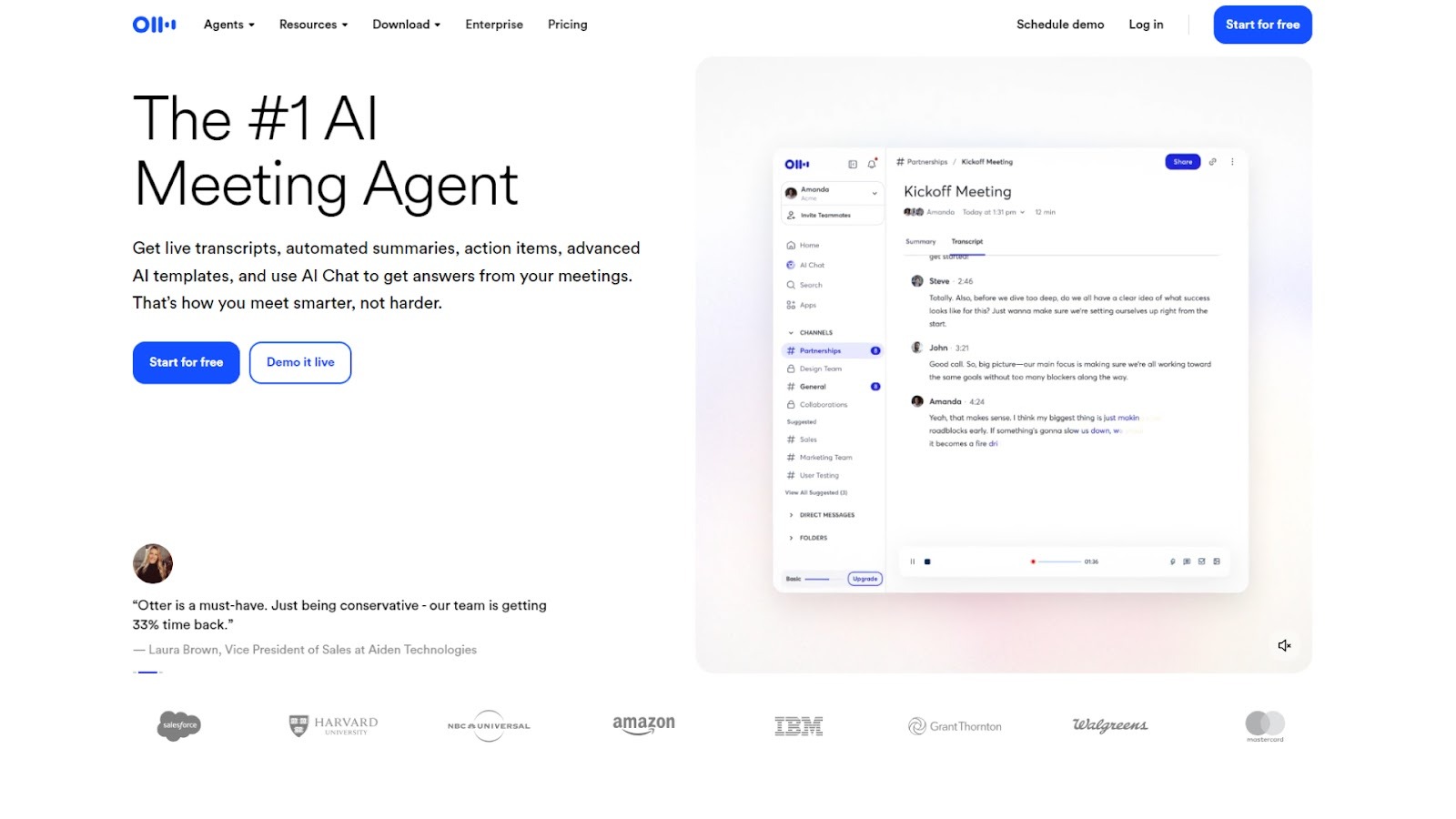
Otter.ai is an advanced AI‑powered transcription and note‑taking tool that automates the process of recording, transcribing, and summarizing meetings in real time. It serves as a personal assistant for product owners and managers, transforming spoken content into structured, searchable, and actionable data.
It can capture conversations from various platforms, including Zoom, Google Meet, and Microsoft Teams, making it an ideal tool for remote teams and individuals who need a seamless, automated way to generate meeting notes and insights.
Key Features
- Real-Time Transcription: Captures and transcribes conversations as they happen, syncing audio with text across web, desktop, and mobile platforms.
- Speaker Identification: Automatically detects and tags different speakers during meetings for clear differentiation in transcripts.
- Keyword Search: Quickly locate important phrases or topics within your transcripts, making it easier to reference key discussion points.
- Automated Summaries: AI generates concise meeting summaries that highlight key takeaways and action items.
- Team Workspace: Provides collaborative features for teams, including shared vocabularies, activity insights, and priority support.
Free Plan & Pricing Models
Otter.ai offers a free plan with 300 monthly transcription minutes (30 minutes per conversation). Paid plans provide extended transcription limits and additional team features.
Also Read: Best Team Productivity Apps & Tools | Clockwise
8. Zeda.io
Source:- https://zeda.io/
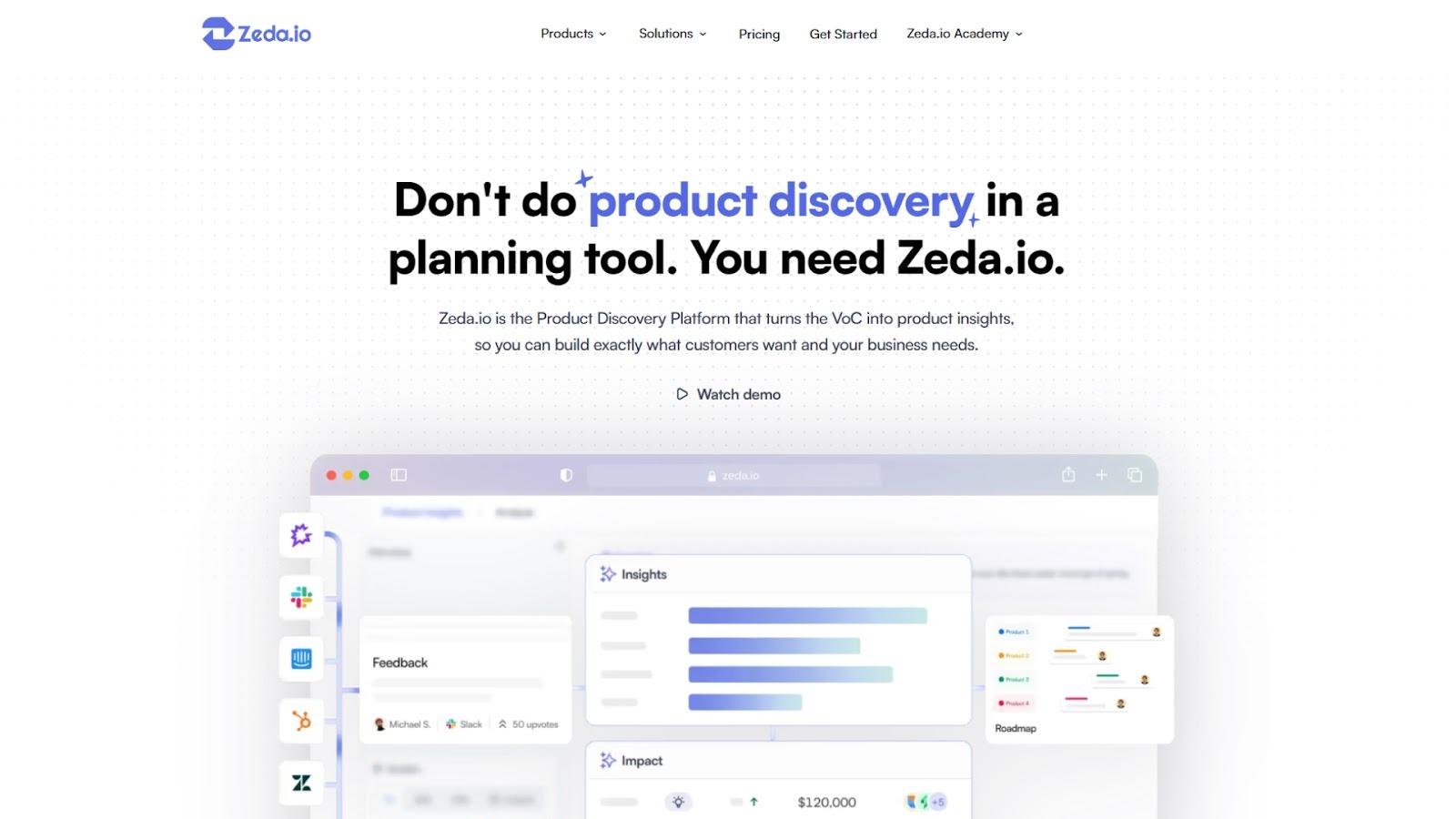
Zeda.io is an AI‑powered product management platform designed to streamline and accelerate product development processes. It acts as a comprehensive feedback management system that synthesizes user data, customer feedback, and team inputs into actionable insights.
The AI algorithms analyze user sentiment and highlight recurring issues, allowing product managers to focus on high‑impact areas of development.
Key Features
- AI‑Driven Feedback Analysis: Automatically tags feedback, detects trends, and generates insights from customer data to guide product development.
- Product Documentation Generation: Uses AI to assist in creating product requirement documents (PRDs), release notes, and other strategic documents.
- Roadmap and Strategy Management: Align product goals with initiatives, build strategy maps, and track progress all in one platform.
- Integration with Engineering Workflows: Connects customer feedback directly to engineering tasks, enabling teams to prioritize high-impact features.
- Centralized Feedback Collection: Gathers feedback from multiple channels, enabling product teams to focus on high-priority requests and features.
Free Plan & Pricing Models
Zeda.io offers a 14-day free trial, with paid plans starting at $499/month for full access to advanced features and enterprise-level tools.
9. Atlassian Intelligence
Source:- https://www.atlassian.com/software/jira
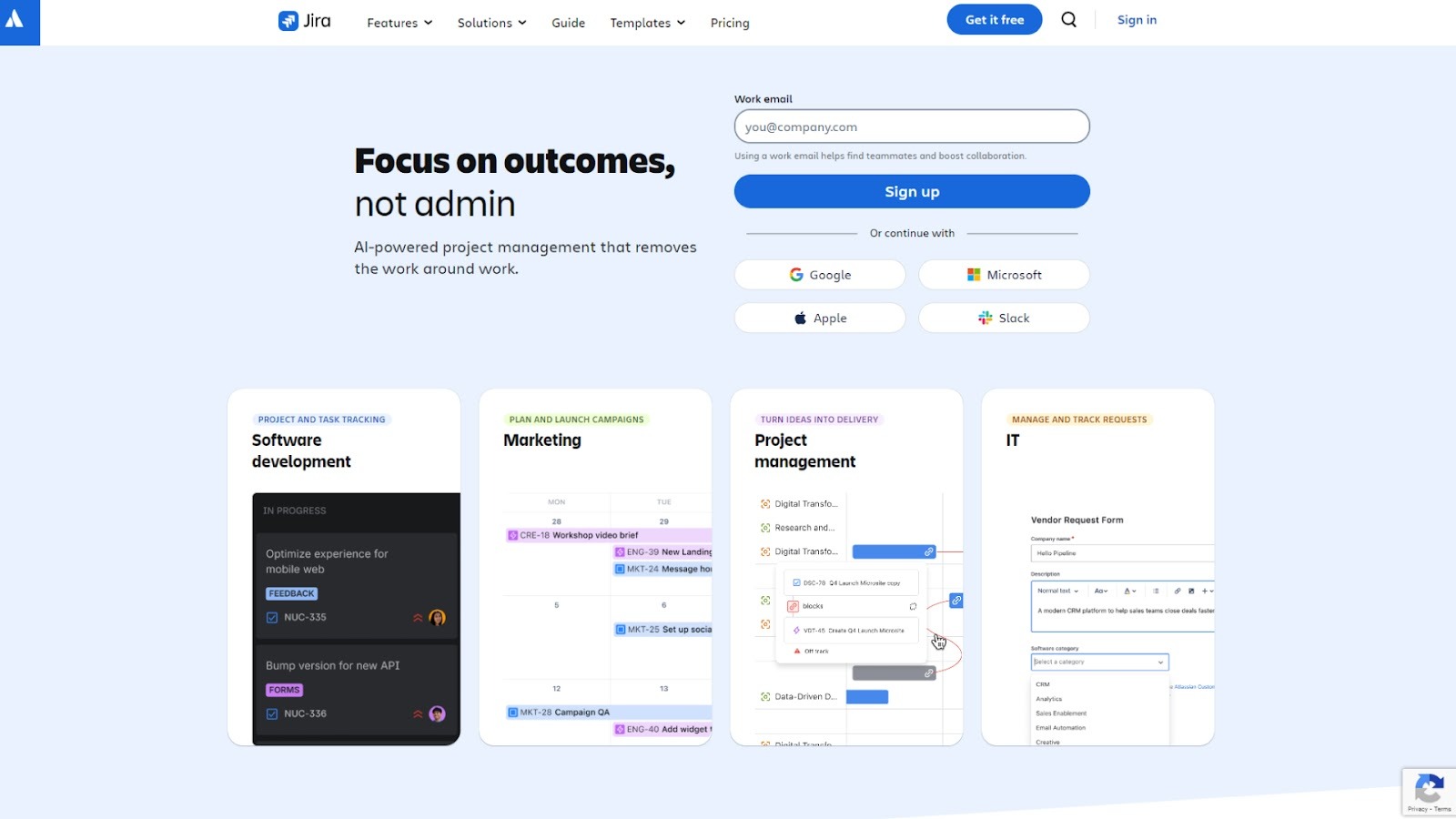
Atlassian Intelligence is a suite of AI‑powered features embedded within the Jira, Confluence, Trello, and other Atlassian cloud apps. It enables product owners and managers to generate and transform content, summarize work items, search across knowledge bases, and gain insights from organizational data, all within the tools they already use.
Key Features
- Content Generation & Transformation: Draft work‑item descriptions, change tone of content, and generate summaries in Jira, Confluence, and Trello.
- Virtual Agent & Natural‑language Search: Use plain‑language queries across your issue tracker or knowledge base to quickly locate work, decisions, or documentation.
- Automation & Workflow Intelligence: Generate automation rules, triage tickets, and summarize alerts or comments in Jira Service Management.
- Summarization on Scale: Summarize large sets of comments, documents, or tickets across the organisation to support decision‑making.
- Admin Controls & Data Governance: Admins control which apps get AI features, set permissions, and ensure data compliance
Free Plan & Pricing Models
Atlassian Intelligence is available for Standard, Premium, and Enterprise plans across Atlassian cloud products; pricing varies by product and plan tier.
10. ChatGPT
Source:- https://chatgpt.com/
ChatGPT is an AI conversational assistant developed by OpenAI, widely used by product owners and managers to support tasks like drafting user stories, summarizing meeting notes, generating release‑ready content, and automating routine communications. It operates both as a standalone web application and integrates with other tools and workflows via its API.
Key Features
- Natural‑Language Prompting: Users can ask in everyday language (for example, “Draft a user story for new mobile onboarding”) and receive structured output.
- Custom GPTs & Workspace Collaboration: Teams can create tailored GPTs or shared workspaces to align responses with internal style, process, or domain knowledge.
- File Upload & Multimodal Input: Upload documents (PDFs, spreadsheets) and request summaries, insights, or task lists based on their content. Business‑Grade Privacy & Admin Controls: Business plans include features like SAML/SSO, data encryption, and compliance with standards such as ISO/IEC 27001.
- API Access for Automation: Enables product teams to embed ChatGPT capabilities into their own tools (e.g., backlog systems, feedback hubs) through the OpenAI API.
Free Plan & Pricing Models
ChatGPT offers a free tier with basic features, including GPT‑5 access with limited usage. Paid plans include:
- “Plus” at $20/month for individual users with expanded access.
- “Business/Enterprise” plans with advanced features and team support; pricing varies based on organization size and features.
Conclusion
AI tools are becoming integral for product owners and managers to handle the complexities of their roles. These tools not only automate repetitive tasks but also provide valuable insights to improve decision-making, streamline workflows, and improve team collaboration.
By using AI, product managers can prioritize tasks, manage sprints more efficiently, and communicate with stakeholders seamlessly.
Clockwise, with its AI-powered calendar optimization, helps product owners reduce scheduling conflicts and ensure uninterrupted focus time. Get started today with Clockwise for a more organized and efficient approach to product management.
FAQs
1. What are the 4 types of AI tools?
AI tools generally fall into four categories: Predictive AI, which forecasts trends; Descriptive AI, which analyzes past data to provide insights; Prescriptive AI, which suggests actions based on data; and Cognitive AI, which simulates human reasoning to make decisions.
2. What is the 30% rule for AI?
The 30% rule suggests that AI automation can typically take over about 30% of tasks within a given role. This allows workers to focus on more complex, strategic tasks while AI handles repetitive processes.
3. How to become an AI product owner?
To become an AI product owner, you should have strong expertise in both AI technology and product management. Develop a solid understanding of AI use cases, user-centric design, and how AI can solve real-world problems for your target audience.
4. What are the 5 levels of a product owner?
The five levels of product ownership are: Entry-Level, where basic skills are learned; Intermediate, focusing on strategy and product development; Advanced, leading cross-functional teams; Expert, managing complex product portfolios; and Strategic, overseeing business-wide product vision and direction.
5. What is the 3-5-3 rule in Scrum?
The 3-5-3 rule in Scrum refers to the ideal number of people in different Scrum ceremonies: 3 roles (Product Owner, Scrum Master, and Team); 5 Scrum events (Sprint, Planning, Daily Scrum, Review, and Retrospective); and 3 core Scrum artifacts (Product Backlog, Sprint Backlog, and Increment).
About the author

Kacy is the VP of Marketing at Clockwise, where she's spent the last three years helping companies transform their approach to time management and team productivity. As a working mother of two, she brings both professional insight and personal experience to conversations about maximizing precious time. Kacy draws inspiration from thought leaders like Cal Newport, Jake Knapp, and Cassie Holmes, applying their principles to help modern teams work smarter. When she's not nerding out on calendar management techniques, you can find her striving to create balance and intentionality in her own life, both at home and in the office.
.gif)
.png)